Anchored Expert Sampling
Keep high-confidence experts as anchors and explore only within a plausible candidate pool. This preserves the model’s reliable computation path while leaving explicit capacity for alternative experts.
Mixture-of-Experts Reinforcement Learning
Explore alternative sparse computation paths during rollout—beyond conventional token-level sampling.
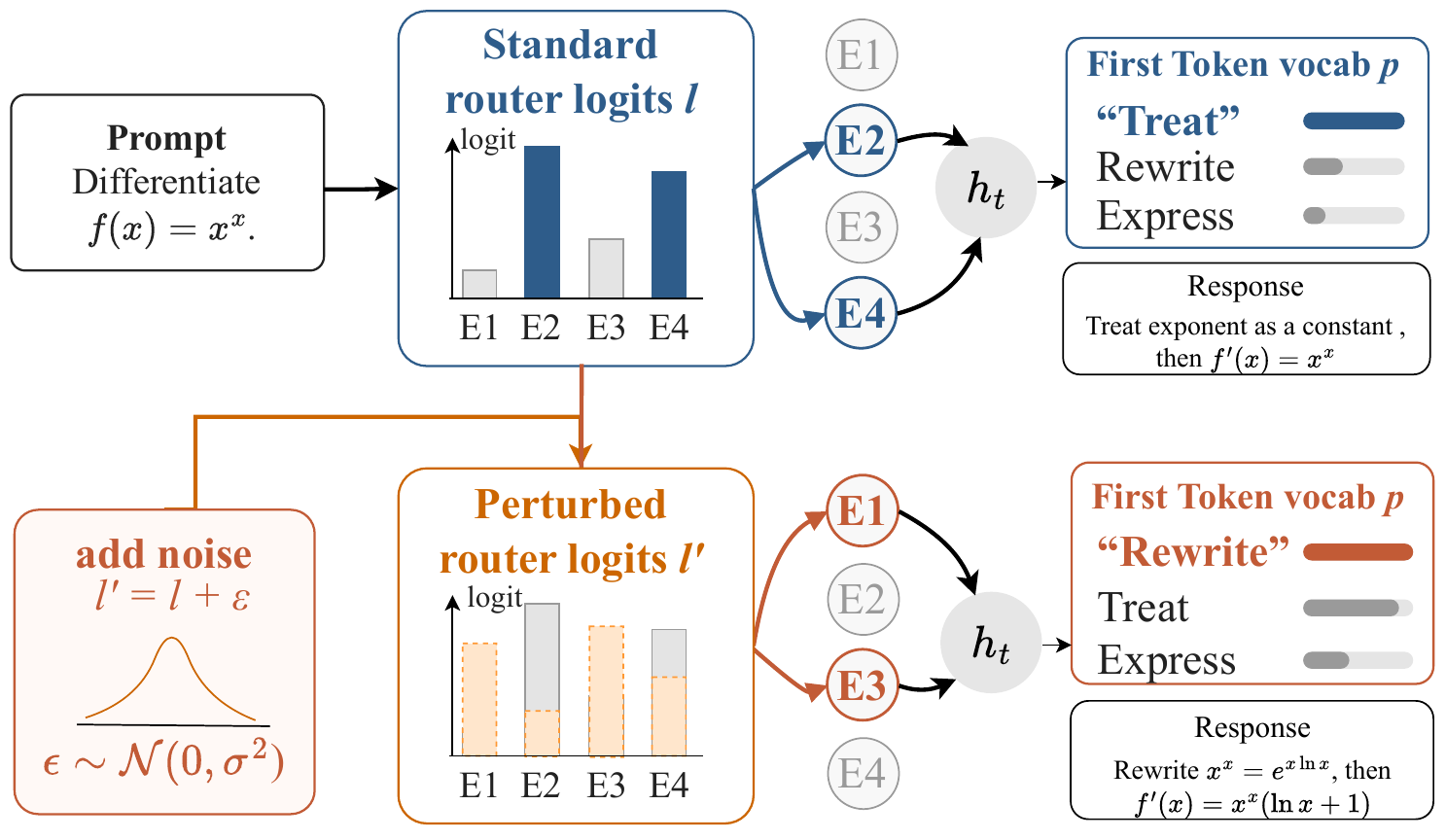
Sparse expert routing introduces an overlooked exploration dimension: a model can vary not only its sampled tokens, but also the internal expert trajectories used to generate them.
Existing reinforcement-learning exploration is primarily implemented through token sampling, while the sparse computation structure of Mixture-of-Experts models remains deterministic. Yet each routing decision selects only a small subset of experts from a much larger expert pool. Perturbing this decision changes intermediate representations before decoding takes place, allowing the same prompt and token prefix to traverse alternative computation paths and produce complementary solutions.
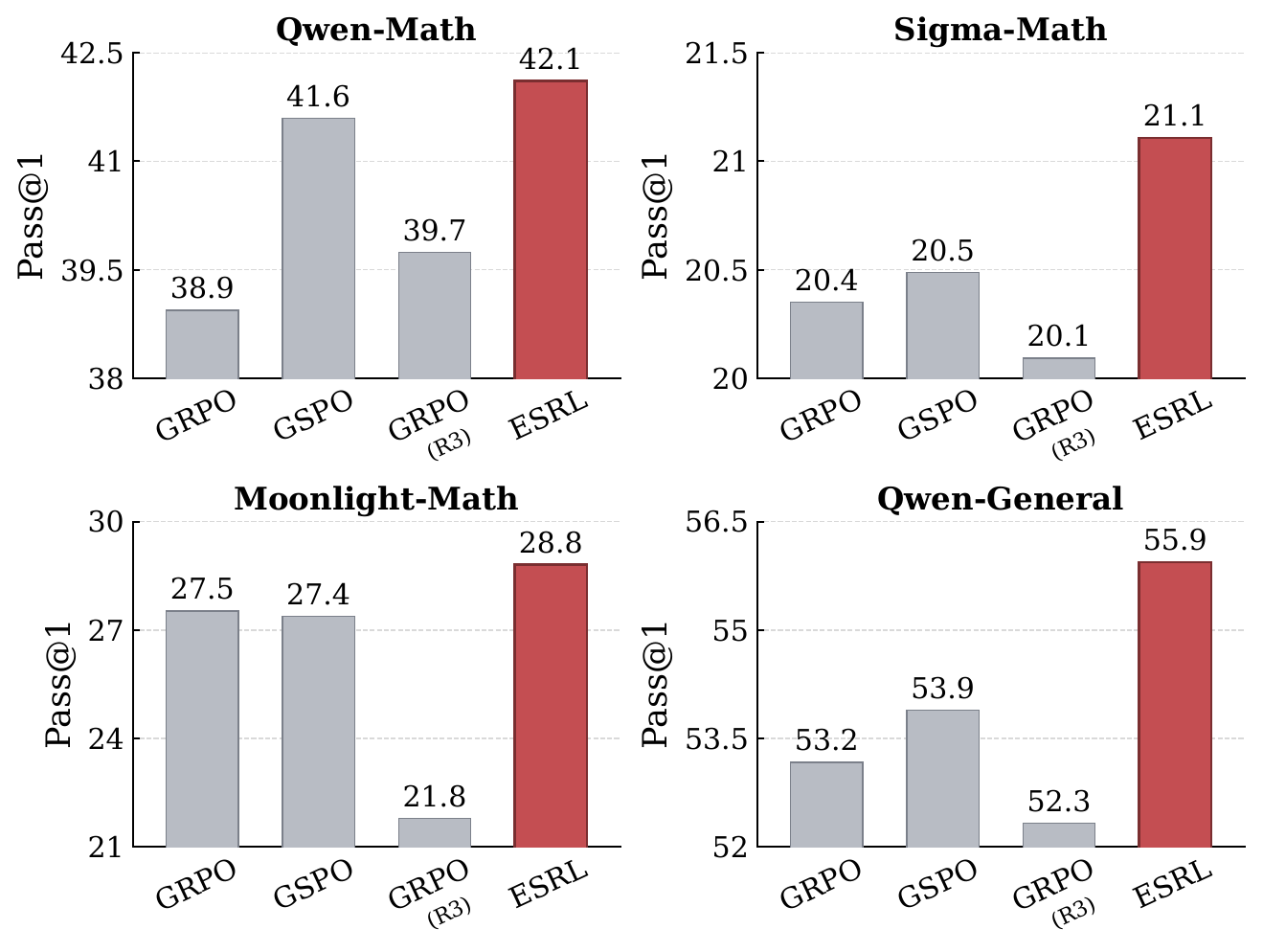
We introduce Expert-Space Exploration Reinforcement Learning (ESRL), which makes this latent routing space directly explorable through anchored expert sampling, entropy-adaptive noise, and rollout routing replay. ESRL improves the primary Qwen3-30B-A3B setting by 3.2 percentage points in average Pass@1 and 4.5 points in Pass@8 over GRPO. The improvements extend across mathematical, scientific, and coding benchmarks and remain consistent on Sigma and Moonlight MoE architectures, supporting expert-space exploration as a general mechanism rather than a backbone-specific adjustment.
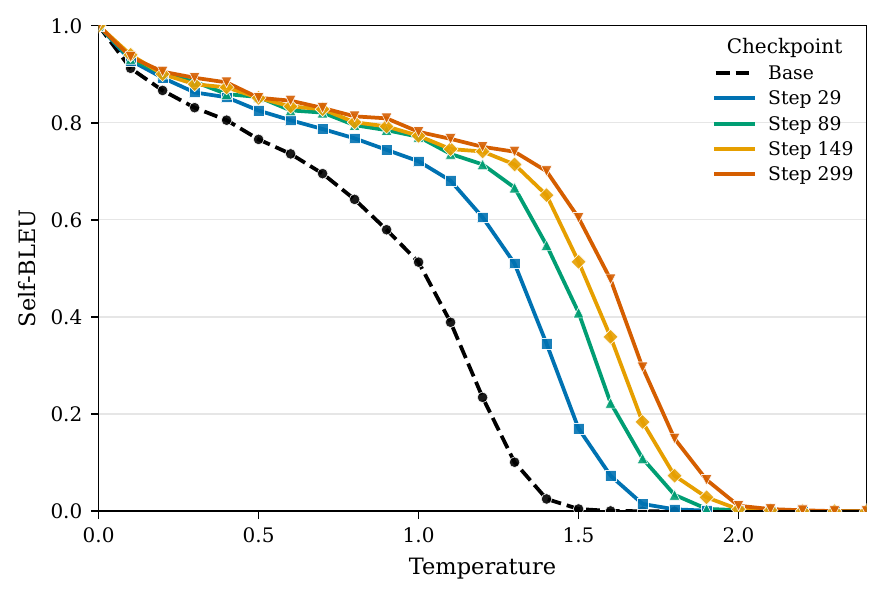
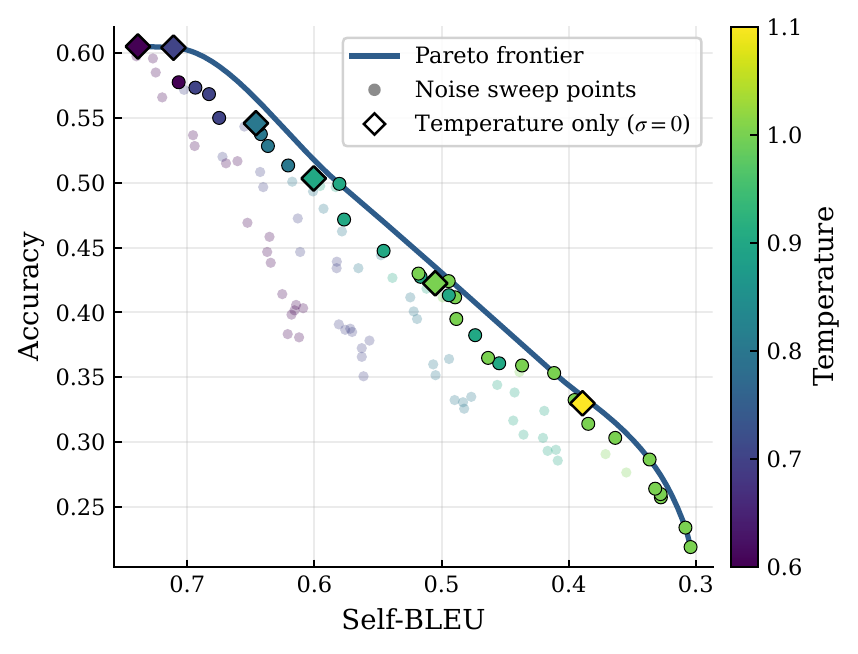
We trace routing perturbations from the router itself to token distributions, complete sequences, and finally the diversity–quality frontier.
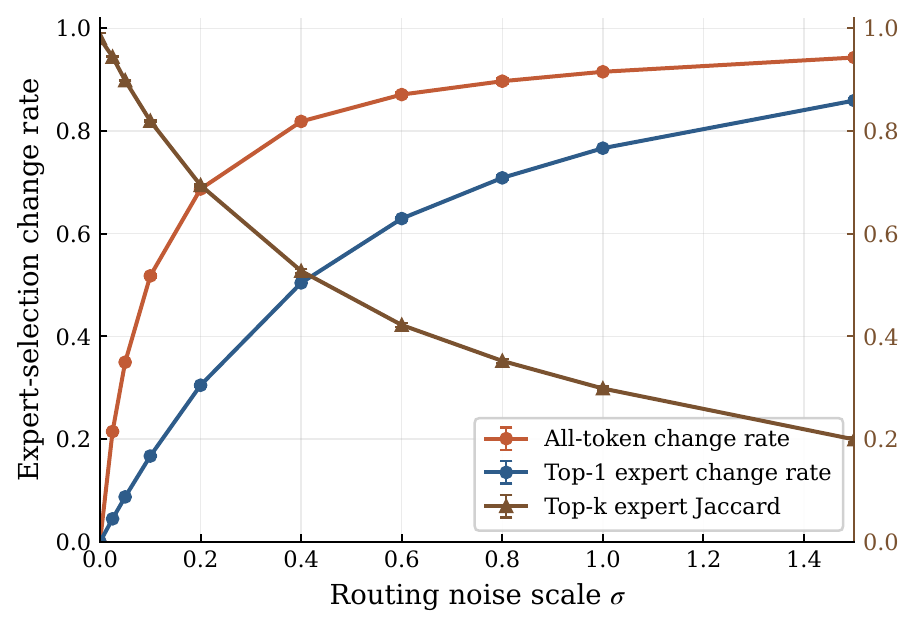
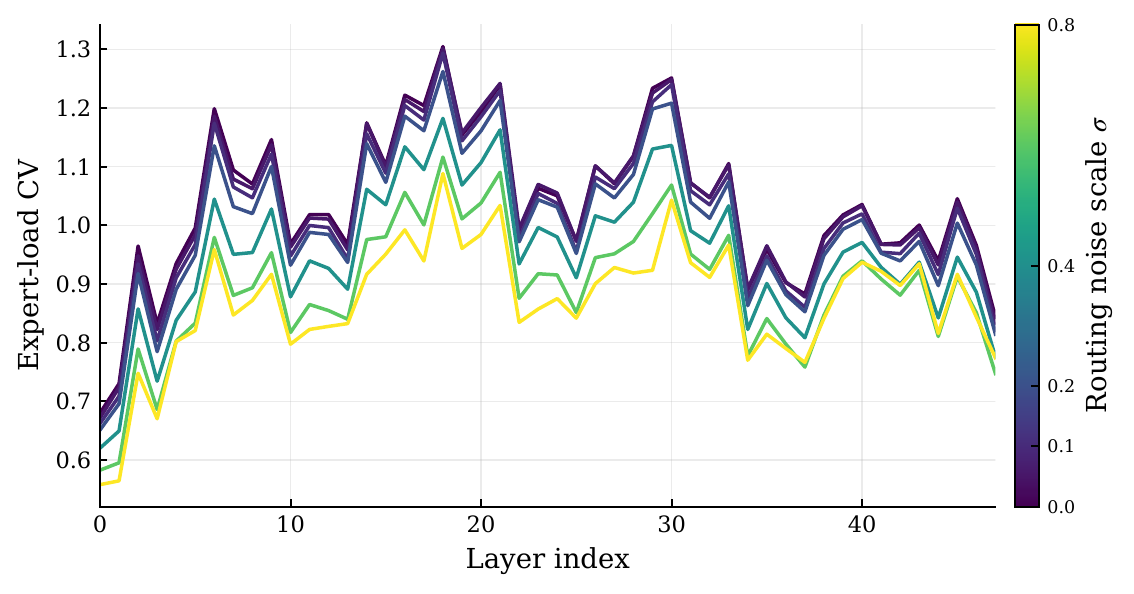
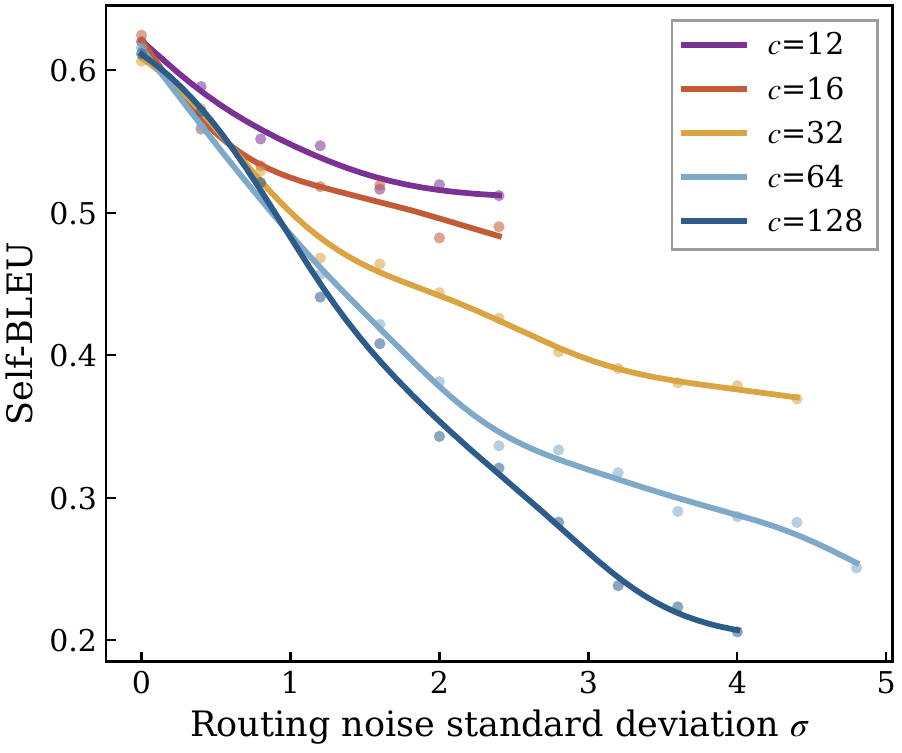
Increasing routing-noise scale raises expert change rates and reduces path overlap. Layer-wise load profiles show that the effect is distributed across the network rather than concentrated in a few isolated layers. Together, these measurements verify that router perturbation changes the actual sparse computation graph.
The vanilla top-1 token drops in rank and top-20 overlap decreases. PCA projections show movement in the full next-token distribution, not just a swap between near-tied candidates. Expert-path variation therefore reaches the decoder as a meaningful change in predictive belief.
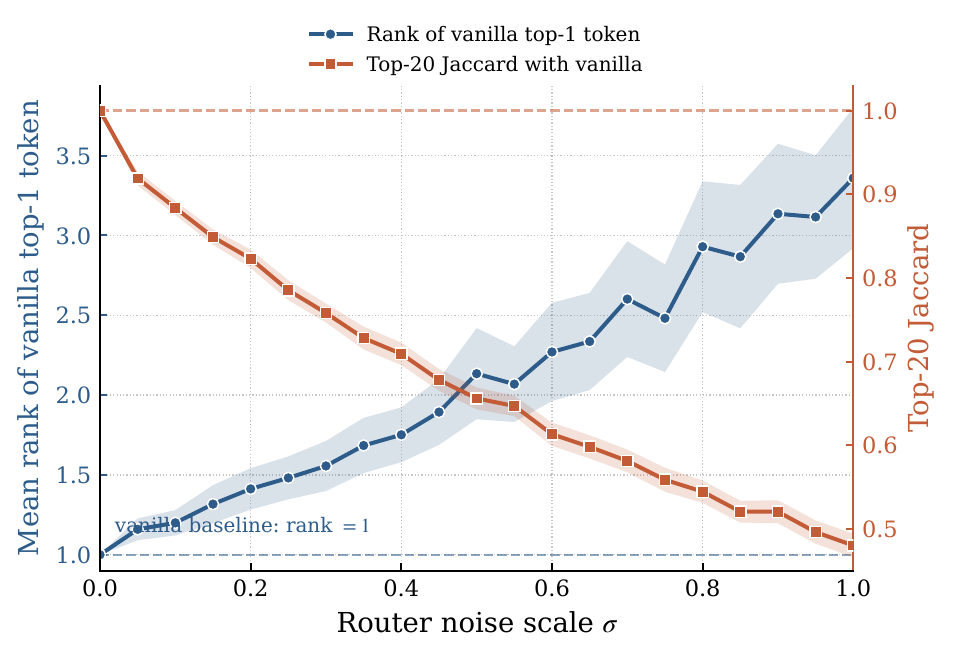
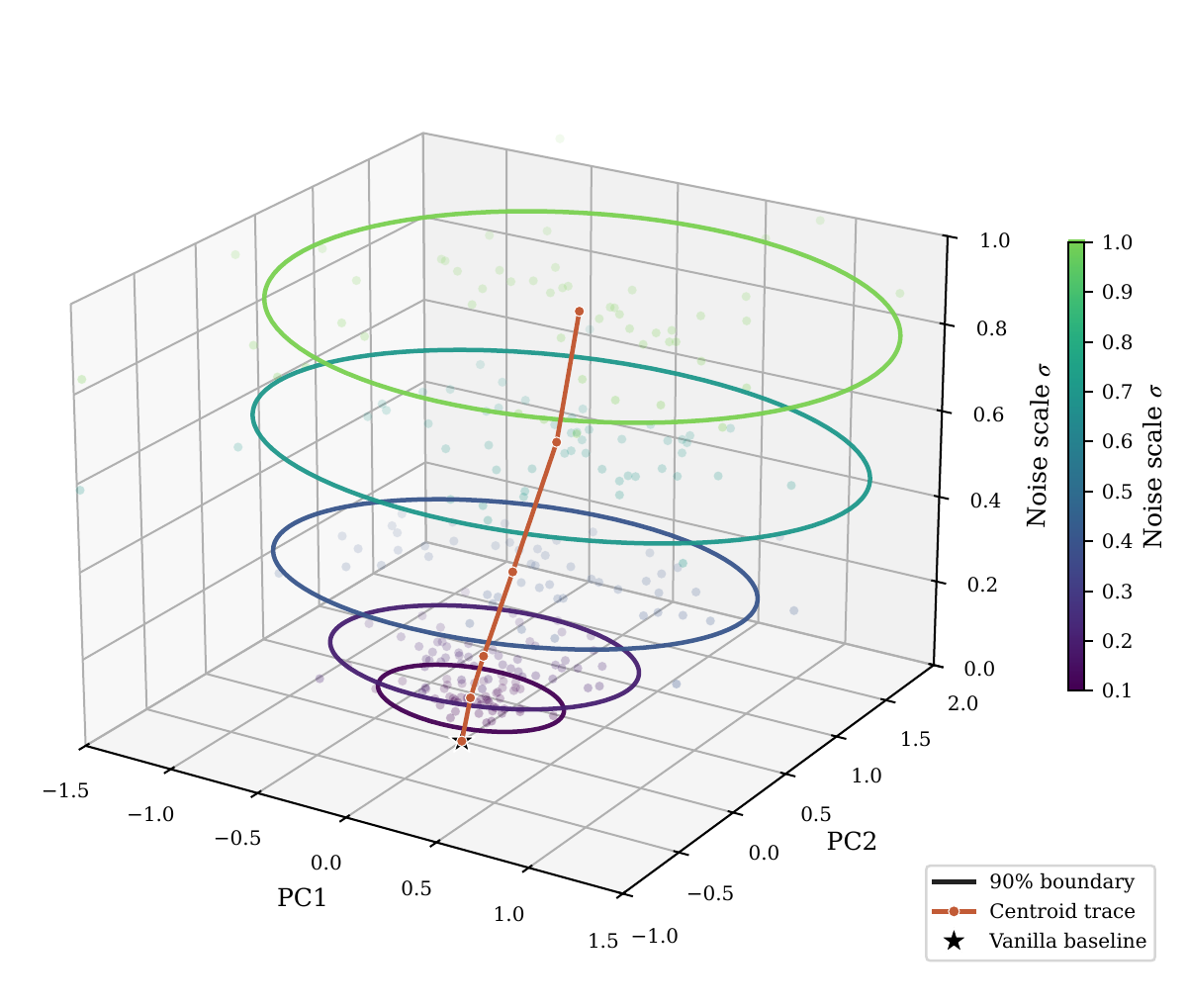
Expert-space perturbations reduce response similarity across checkpoints and decoding temperatures, so routing diversity survives autoregressive generation. The resulting differences accumulate into distinct solution strategies rather than disappearing after the first few tokens.
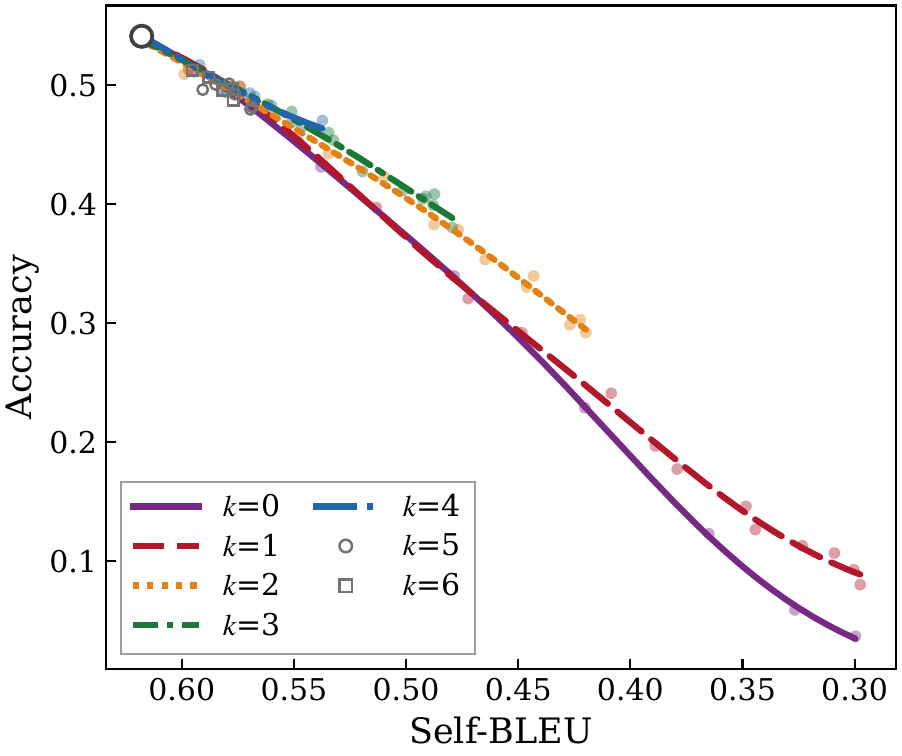
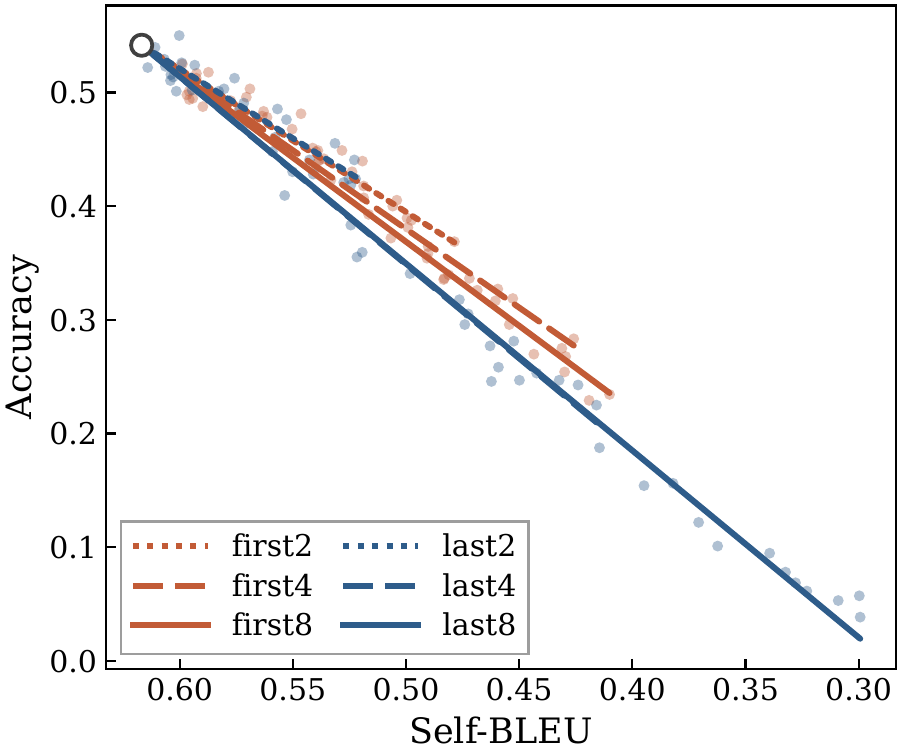
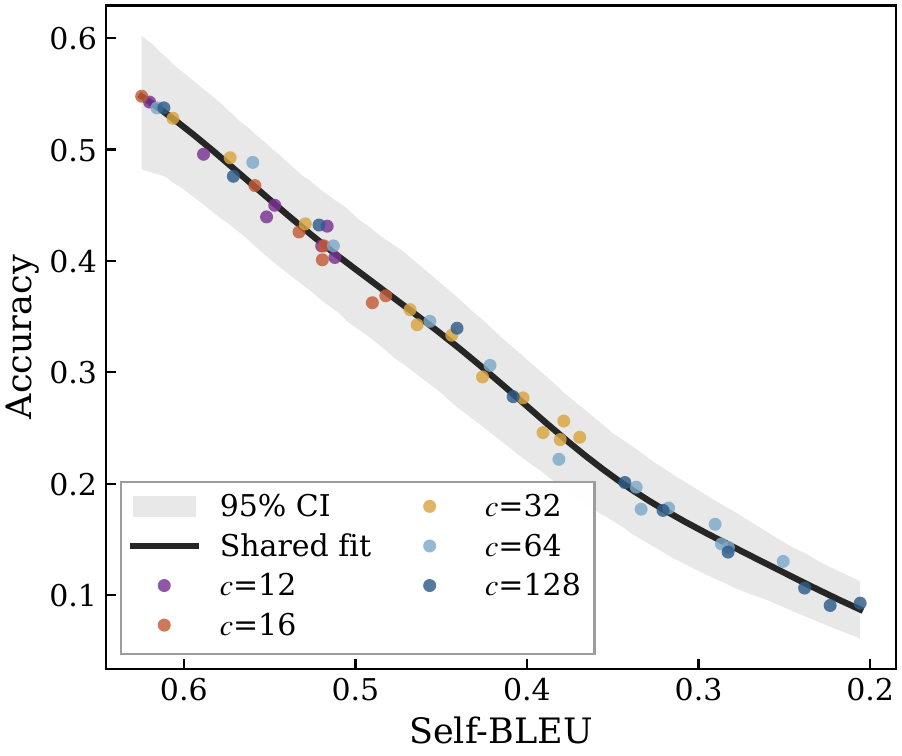
Unconstrained diversity can damage accuracy. This frontier motivates anchoring reliable experts, exploring plausible alternatives, and adapting noise to router uncertainty. ESRL is designed to move the frontier rather than maximize route changes in isolation.
ESRL expands routing diversity while protecting rollout quality and preserving the expert paths used for policy optimization. Its three components separately control where exploration occurs, how strongly each token is perturbed, and how the sampled path is aligned with the subsequent update.
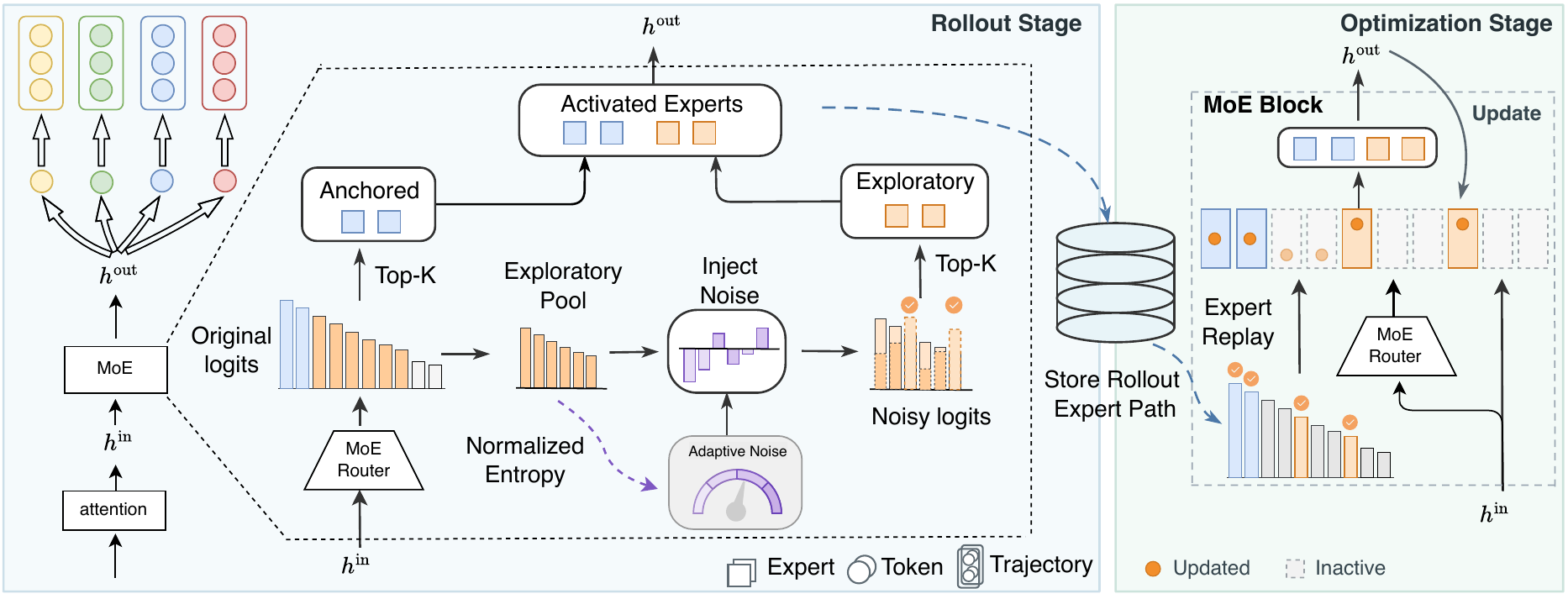
Keep high-confidence experts as anchors and explore only within a plausible candidate pool. This preserves the model’s reliable computation path while leaving explicit capacity for alternative experts.
Scale routing perturbations with token-wise router uncertainty instead of applying fixed noise everywhere. Confident tokens receive conservative perturbations, whereas uncertain decisions are given more room to explore.
Replay the rollout expert path during optimization to remove rollout–training routing mismatch. The policy is therefore updated on the same sparse computation graph that produced the sampled response.
We first evaluate final-task performance across models and domains, then examine robustness and learning dynamics. Component ablations, parameter sweeps, and decoupled training further identify which design choices produce the gain and how they affect exploration quality.
ESRL improves mathematical reasoning on the primary Qwen3 setting and consistently transfers across three distinct MoE routing architectures. The same exploration mechanism also improves science and code, showing that the benefit is not tied to a single reasoning format or expert topology.
| Method | Olympiad | AIME | AMC | Minerva | Average | |||||
|---|---|---|---|---|---|---|---|---|---|---|
| P@1 | P@8 | P@1 | P@8 | P@1 | P@8 | P@1 | P@8 | P@1 | P@8 | |
| GRPO | 51.2 | 70.2 | 21.9 | 43.1 | 41.9 | 72.8 | 40.8 | 52.6 | 38.9 | 59.7 |
| GRPO-R3 | 52.0 | 70.6 | 22.8 | 46.0 | 43.9 | 73.9 | 40.3 | 53.7 | 39.7 | 61.1 |
| GSPO | 51.8 | 70.6 | 24.4 | 51.7 | 48.8 | 77.2 | 41.4 | 53.7 | 41.6 | 63.3 |
| RO-GRPO | 51.5 | 70.9 | 22.4 | 44.3 | 47.2 | 80.4 | 41.4 | 51.5 | 40.6 | 61.8 |
| Aux-Loss | 39.1 | 64.8 | 13.3 | 40.6 | 26.2 | 57.6 | 34.5 | 52.9 | 28.3 | 54.0 |
| N-Sampling | 33.1 | 62.8 | 16.7 | 37.7 | 18.9 | 52.2 | 27.7 | 52.6 | 24.1 | 51.3 |
| ESRL | 53.5 | 72.7 | 24.4 | 52.9 | 49.6 | 78.3 | 41.0 | 52.9 | 42.1 | 64.2 |
ESRL achieves 42.1 average Pass@1 and 64.2 Pass@8—+3.2 and +4.5 percentage points over GRPO. Improvements on AIME and AMC indicate that expert-path exploration is especially useful when a problem admits multiple intermediate reasoning strategies.
| Backbone | Method | Avg. P@1 | Avg. P@8 |
|---|---|---|---|
| Qwen3-30B-A3B | GRPO | 38.9 | 59.7 |
| GSPO | 41.6 | 63.3 | |
| ESRL | 42.1 | 64.2 | |
| Sigma-20B-A0.5B | GRPO | 20.4 | 38.6 |
| GSPO | 20.5 | 40.0 | |
| ESRL | 21.1 | 41.3 | |
| Moonlight-16B-A3B | GRPO | 27.5 | 47.4 |
| GSPO | 27.4 | 47.7 | |
| ESRL | 28.8 | 51.0 |
ESRL improves the aggregate result on Qwen3, Sigma, and Moonlight, covering different expert capacities and routing designs. This cross-backbone consistency suggests that the method operates on a shared property of sparse routing rather than a model-specific router artifact.
| Method | GPQA | MMLU-Pro | MMLU-Redux | LCB v6 | Average | |||||
|---|---|---|---|---|---|---|---|---|---|---|
| P@1 | P@8 | P@1 | P@8 | P@1 | P@8 | P@1 | P@8 | P@1 | P@8 | |
| GRPO | 35.7 | 53.5 | 57.6 | 67.4 | 79.3 | 86.3 | 40.1 | 52.2 | 53.2 | 64.9 |
| GSPO | 38.9 | 66.7 | 60.4 | 76.0 | 75.3 | 90.2 | 41.0 | 53.1 | 53.9 | 71.5 |
| GRPO-R3 | 36.1 | 62.1 | 59.0 | 74.7 | 78.6 | 89.0 | 35.6 | 51.9 | 52.3 | 69.4 |
| ESRL | 39.0 | 76.8 | 62.5 | 82.5 | 80.3 | 94.5 | 42.0 | 54.3 | 55.9 | 77.0 |
The largest coverage gains appear on GPQA and the MMLU variants, while LiveCodeBench improves in both Pass@1 and Pass@8. These results indicate that diverse expert trajectories remain useful beyond mathematical proof-style generation.
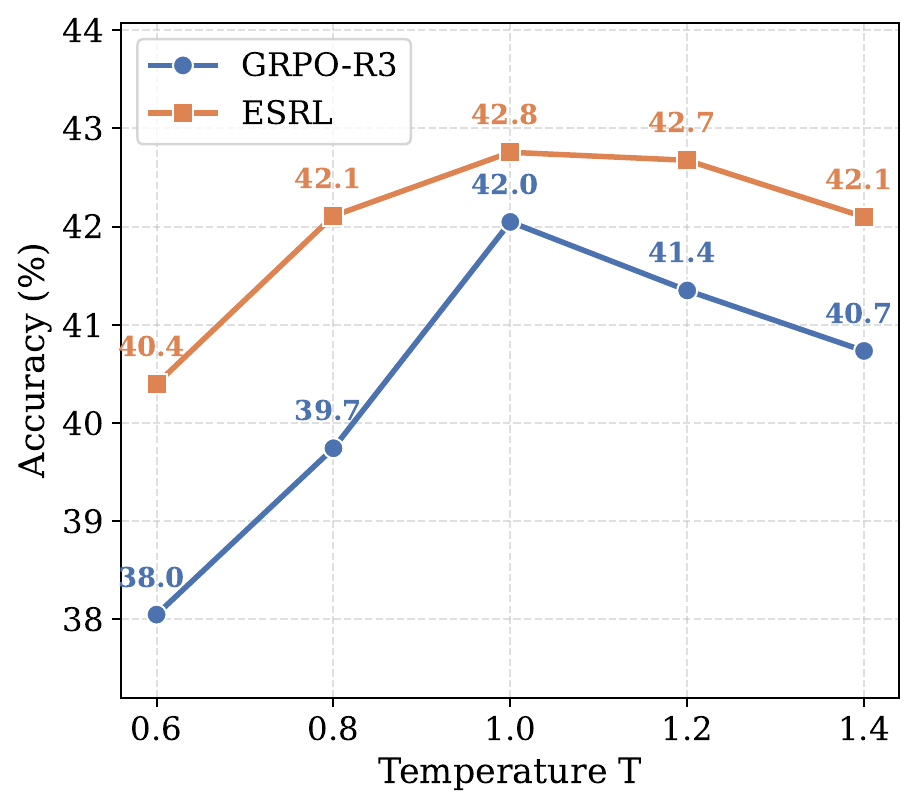
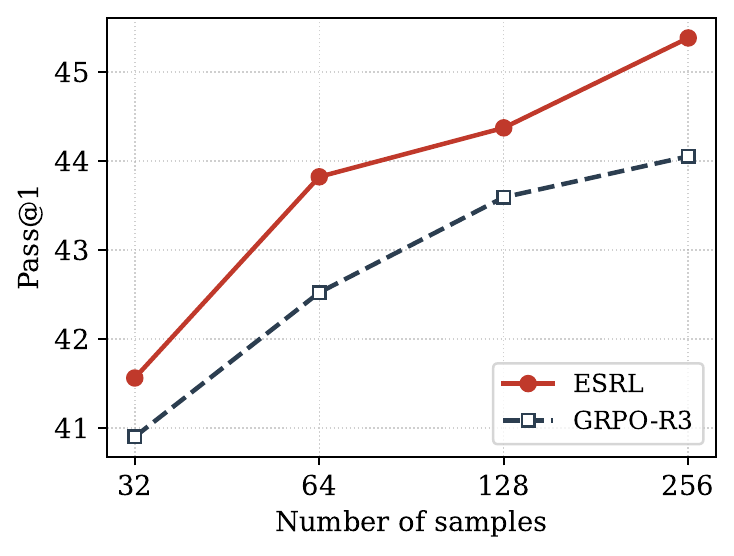
We vary two independent rollout controls: decoding temperature and the number of sampled responses. ESRL stays above GRPO-R3 across both sweeps, showing that its gain is not tied to a single sampling budget. The consistent margin also separates expert-space exploration from simply increasing token-level randomness.
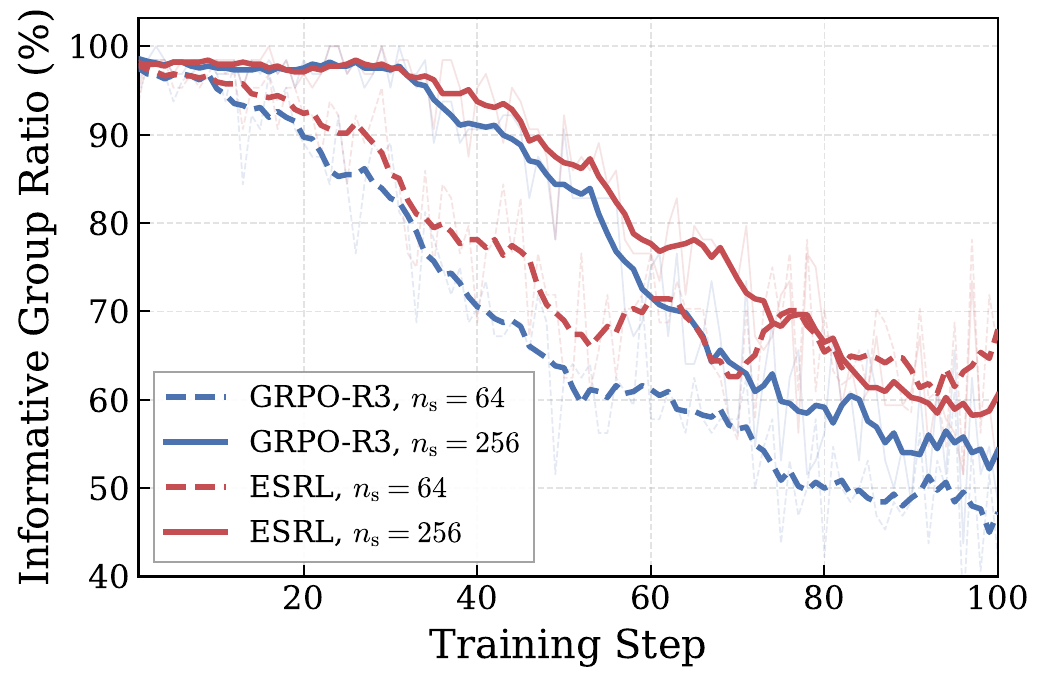
The benefit appears in both the learning signal and expert utilization: ESRL creates more informative groups and changes load concentration over training. We track these quantities throughout optimization to distinguish a sustained learning effect from a transient change in the first few checkpoints.
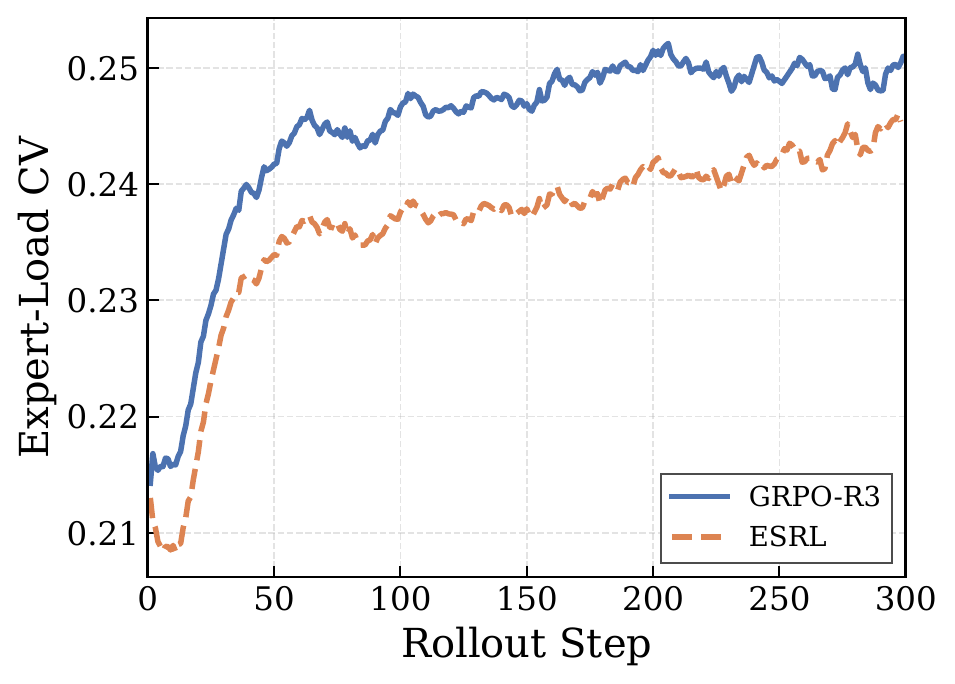
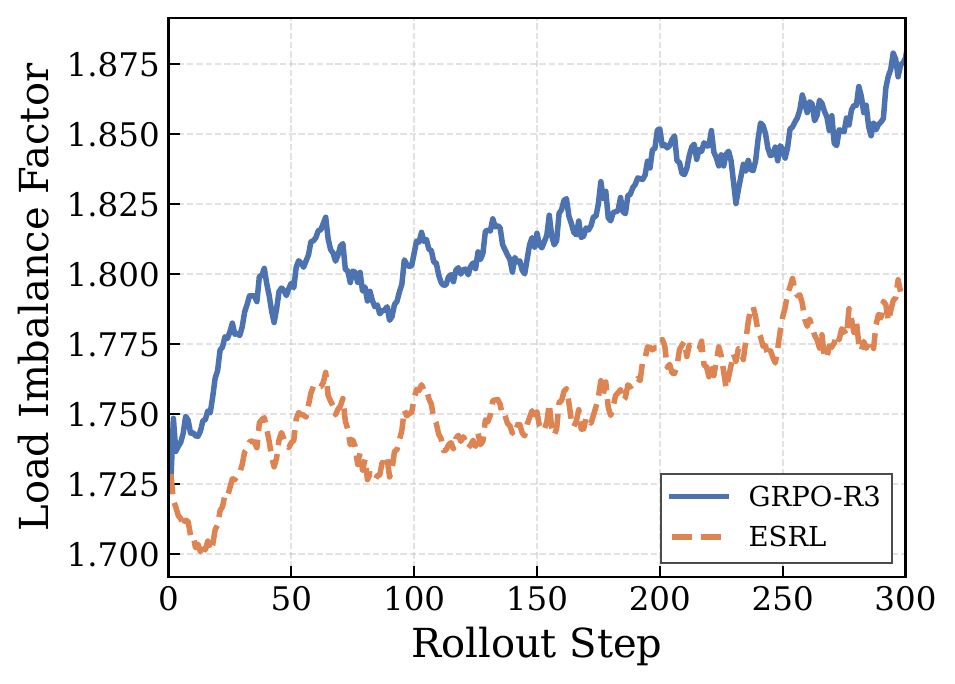
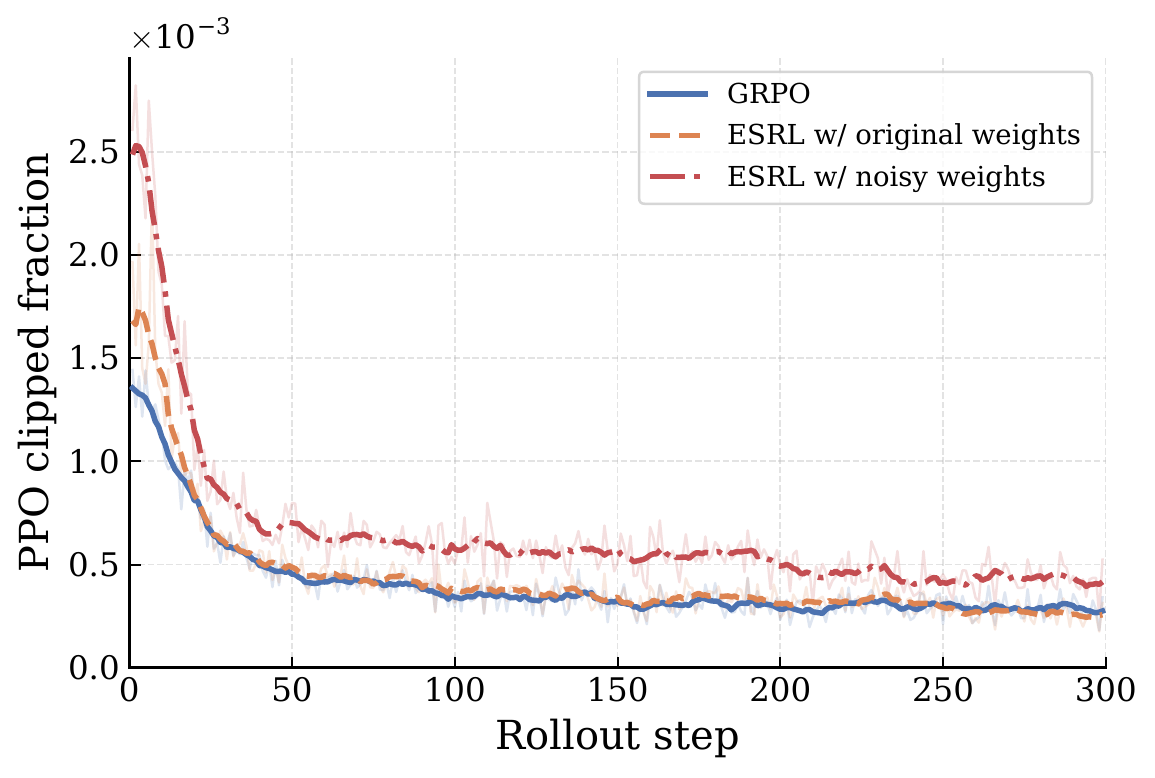
The ablations isolate how selection weights, anchored experts, and adaptive noise protect training stability and rollout quality. Each component addresses a different failure mode: unstable mixture coefficients, implausible expert substitutions, or excessive perturbation on already-confident tokens.
| Method | Olympiad | AIME | AMC | Minerva | Average | |||||
|---|---|---|---|---|---|---|---|---|---|---|
| P@1 | P@8 | P@1 | P@8 | P@1 | P@8 | P@1 | P@8 | P@1 | P@8 | |
| GRPO-R3 | 52.0 | 70.6 | 22.8 | 46.0 | 43.9 | 73.9 | 40.3 | 53.7 | 39.7 | 61.1 |
| ESRL w/ noisy weights | 51.3 | 69.0 | 23.2 | 47.0 | 45.1 | 72.8 | 40.6 | 53.3 | 40.1 | 60.5 |
| ESRL w/ original weights | 53.5 | 72.7 | 24.4 | 52.9 | 49.6 | 78.3 | 41.0 | 52.9 | 42.1 | 64.2 |
Noise should influence expert selection, while clean router logits continue to compute mixture weights. This separation adds discrete route diversity without unnecessarily perturbing the magnitude of the expert combination.
| Configuration | Pass@1 | Pass@8 | ||||||||
|---|---|---|---|---|---|---|---|---|---|---|
| Olympiad | AIME | AMC | Minerva | Avg. | Olympiad | AIME | AMC | Minerva | Avg. | |
| GRPO-R3 | 52.0 | 22.8 | 43.9 | 40.3 | 39.7 | 70.6 | 46.0 | 73.9 | 53.7 | 61.1 |
| Ksafe=4, M=16 | 53.5 | 24.4 | 49.6 | 41.0 | 42.1 | 72.7 | 47.3 | 78.3 | 52.9 | 62.8 |
| Ksafe=4, M=32 | 53.3 | 24.6 | 47.6 | 41.4 | 41.7 | 71.8 | 49.2 | 78.3 | 53.7 | 63.2 |
| Ksafe=2, M=16 | 52.6 | 26.0 | 46.9 | 41.0 | 41.6 | 72.9 | 53.1 | 79.4 | 54.4 | 64.9 |
| Ksafe=2, M=32 | 52.6 | 24.8 | 49.5 | 41.6 | 42.1 | 70.5 | 46.5 | 78.3 | 52.9 | 62.1 |
| No anchored experts | 52.3 | 22.3 | 45.8 | 40.8 | 40.3 | 70.9 | 45.8 | 75.0 | 51.5 | 60.8 |
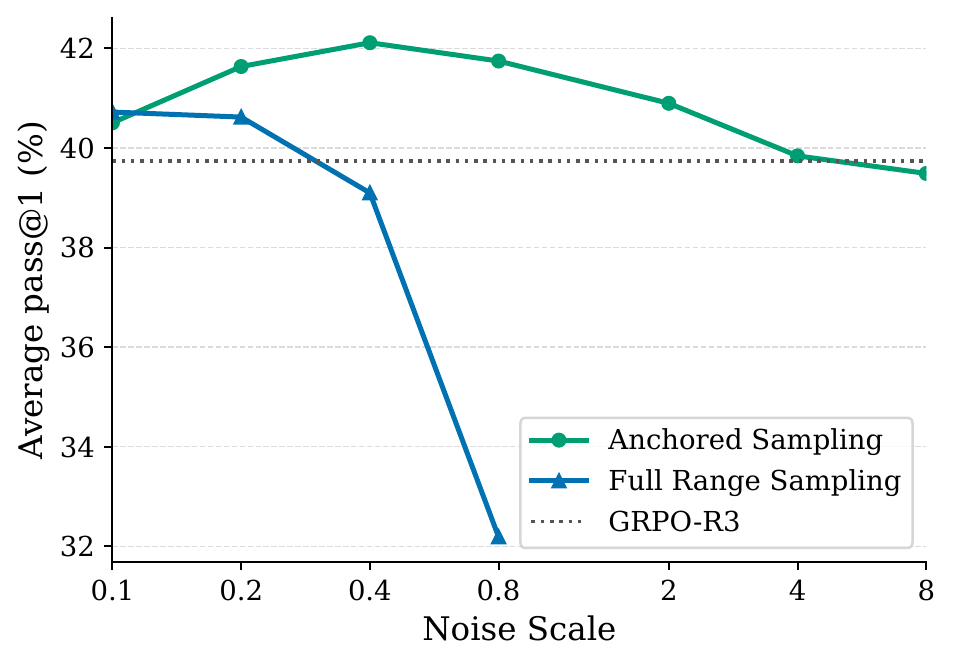
Anchoring avoids the collapse of full-range sampling; Ksafe=2, M=16 gives the strongest Pass@8 in this sweep. The anchor keeps a reliable computation core while the remaining expert slots introduce controlled alternatives.
| Configuration | Pass@1 | Pass@8 | ||||||||
|---|---|---|---|---|---|---|---|---|---|---|
| Olympiad | AIME | AMC | Minerva | Avg. | Olympiad | AIME | AMC | Minerva | Avg. | |
| GRPO-R3 | 52.0 | 22.8 | 43.9 | 40.3 | 39.7 | 70.6 | 46.0 | 73.9 | 53.7 | 61.1 |
| Non-adaptive noise | 50.3 | 20.8 | 42.7 | 40.9 | 38.7 | 70.0 | 42.8 | 69.6 | 55.9 | 59.6 |
| Adaptive noise | 53.5 | 24.4 | 49.6 | 41.0 | 42.1 | 72.7 | 52.9 | 78.3 | 52.9 | 64.2 |
Entropy-adaptive noise raises average Pass@1 from 38.7 to 42.1 and Pass@8 from 59.6 to 64.2 over fixed noise. Token-wise scaling concentrates exploration on uncertain routing decisions instead of perturbing all tokens equally.
Four sweeps identify where routing exploration helps: anchored-expert count, perturbation position, exploration strength, and candidate-pool frontier. Rather than searching only for the highest accuracy point, we jointly inspect quality and self-BLEU to expose how each parameter moves the exploration frontier.
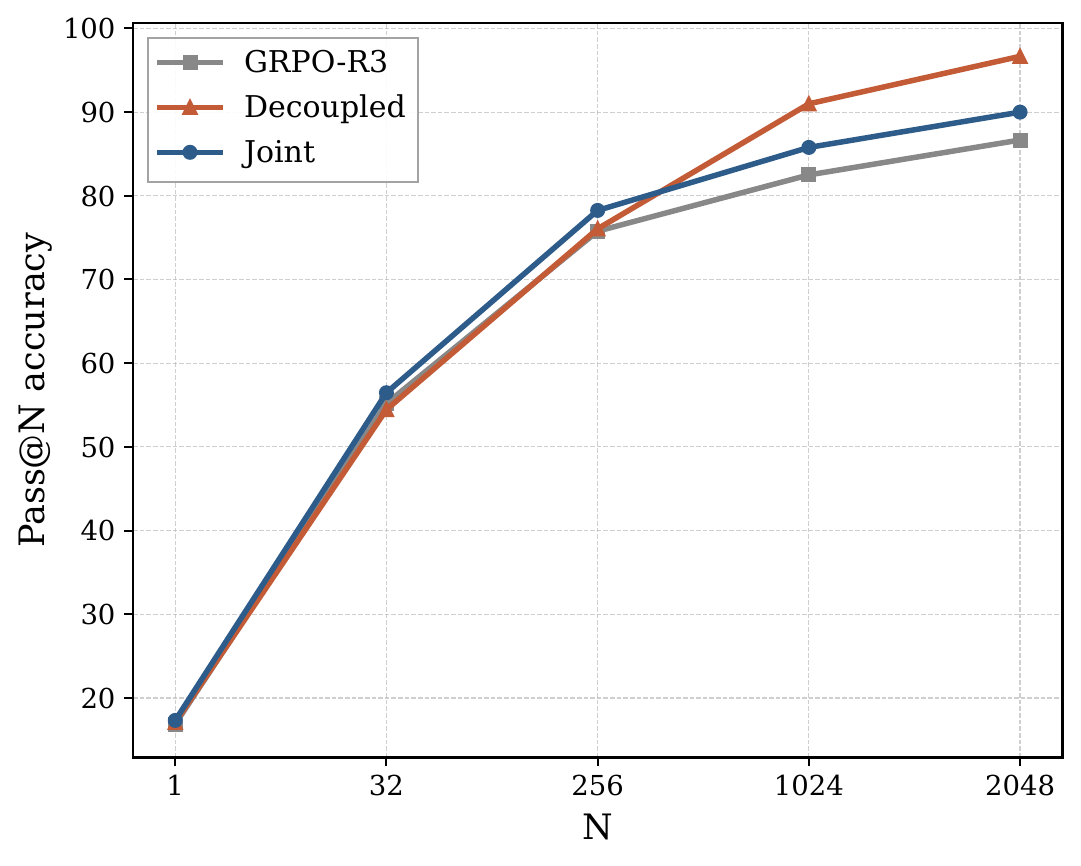
Expert noise can collect alternative trajectories while optimization replays the saved route, decoupling exploration from the policy update. This experiment tests whether expert-space exploration is useful as a rollout-time search mechanism even when the optimization policy itself remains clean and path-consistent.
| Configuration | Pass@1 | Pass@8 | ||||||||
|---|---|---|---|---|---|---|---|---|---|---|
| Olympiad | AIME | AMC | Minerva | Avg. | Olympiad | AIME | AMC | Minerva | Avg. | |
| GRPO-R3 | 52.0 | 22.8 | 43.9 | 40.3 | 39.7 | 70.6 | 46.0 | 73.9 | 53.7 | 61.1 |
| Joint | 53.5 | 24.4 | 49.6 | 41.0 | 42.1 | 72.7 | 52.9 | 78.3 | 52.9 | 64.2 |
| Decoupled | 53.4 | 25.2 | 49.2 | 41.7 | 42.4 | 71.4 | 50.4 | 78.3 | 51.8 | 63.0 |
Decoupling slightly improves average Pass@1, while joint training retains the strongest average Pass@8. Their comparable aggregate performance shows that most of the benefit originates from improved rollout coverage rather than permanently injecting noise into the policy.
If you find ESRL useful in your research, please cite our paper.
@article{he2026esrl,
  title   = {Expert-Space Exploration in {MoE} Reinforcement Learning},
  author  = {He, Hongyi and Lin, Zhenghao and Liu, Xiao and Cheng, Peng and Lu, Yan and Gong, Yeyun},
  journal = {arXiv preprint arXiv:2609.13058},
  year    = {2026},
  doi     = {10.48550/arXiv.2609.13058},
  url     = {https://arxiv.org/abs/2609.13058}
}